Stone House vs Log House: The Great Choice in Modern Architecture
Quick answer: The choice between a Stone House vs Log House depends on your priorities. A stone house traditionally offers a material suited to urban settings, while a modern log house wins on ecology, indoor air quality, and architectural versatility. Contemporary “New World Luxury” increasingly favors carbon-neutral log architecture for its superior nature-inspired design and technical advancement.

Architectural Freedom and Visual Expression
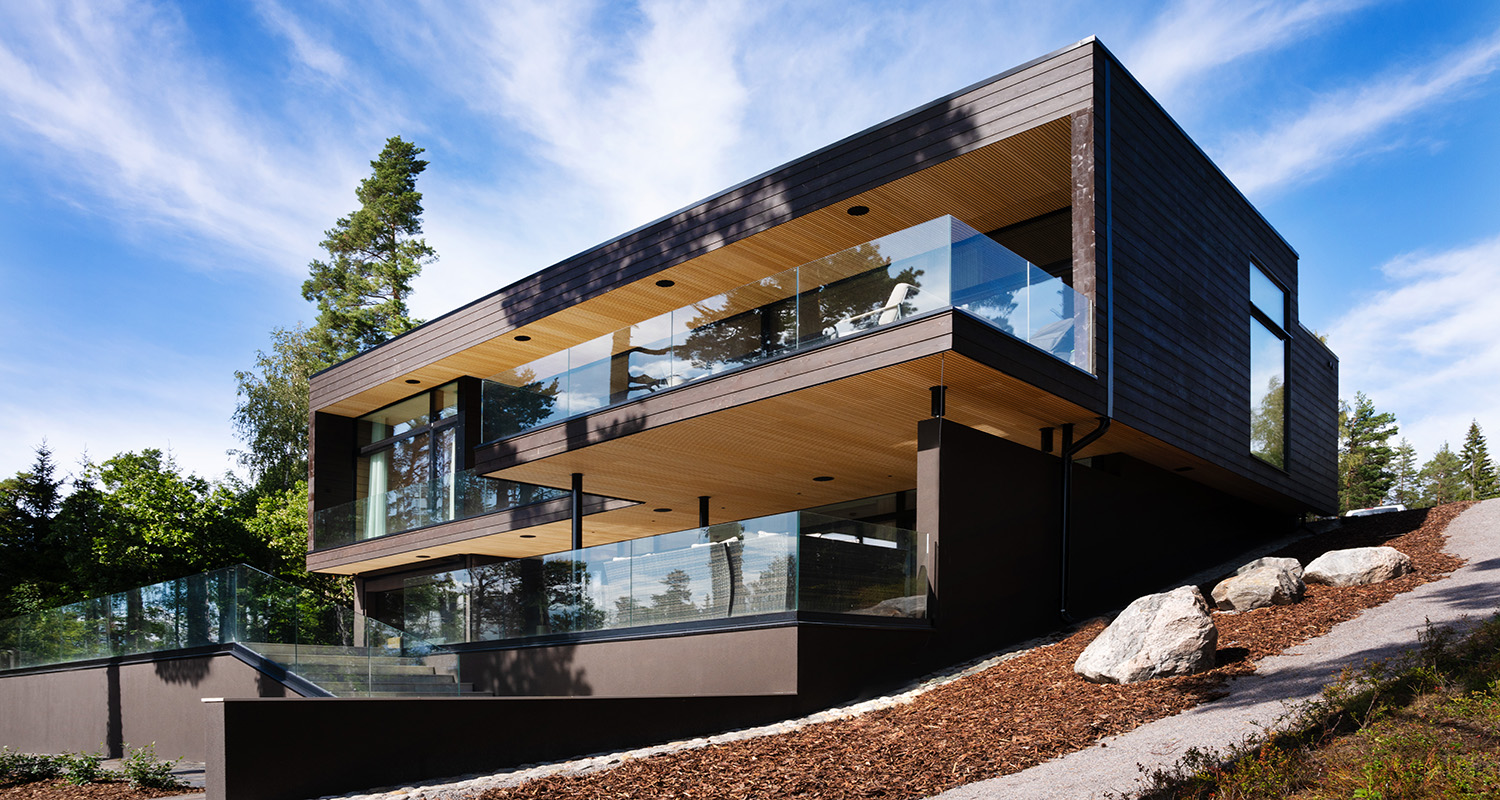
When comparing a stone house and a log house from an architectural standpoint, old assumptions have broken down. A log house no longer means just a round-log cabin, and a stone house is no longer the only option for minimalist, clean-lined design. Modern non-settling log technology now enables large glass surfaces and pared-down architecture that used to be the exclusive domain of stone structures.
A stone house naturally has a clean-lined look. Rendered surfaces and stone cladding create an urban, even sculptural, atmosphere. A log house, on the other hand, brings nature’s own textures. Age-old log construction combined with modern woodworking technology allows different materials to be combined into hybrid structures, where load-bearing logs, other wood elements, lighter glass walls, and even steel meet seamlessly.

Ecology and Carbon Footprint in Construction
Environmental awareness has become the leading criterion in luxury construction. In this category, the log house is a clear winner. Wood is the only renewable building material that sequesters carbon dioxide throughout its life cycle. Producing many stone-construction materials is energy-intensive, which is why their manufacturing-stage CO2 emissions are typically higher than in wood construction.
When the full life-cycle impact of a building is calculated, the log house’s carbon handprint is superior. Both log and stone houses are long-lasting, but their environmental impacts diverge from the very start of construction. The initial emissions from producing a stone house are often many times higher than in wood construction, while wood absorbs carbon as it grows and acts as a long-term carbon store within the building. At the end of its service life, a log house’s materials are also highly recyclable or reusable, reinforcing its position as an ecological building choice.
Indoor Air Quality and Wellbeing
Note: Hygroscopicity
Log is naturally a hygroscopic material, meaning it evens out indoor humidity swings by absorbing and releasing moisture. This keeps indoor air within the optimal range (30–55%), which reduces the spread of viruses and bacteria.
In the Stone House vs Log House comparison, health effects often tilt toward wood. Studies show wood surfaces lower stress levels and heart rate and improve sleep quality. This is called biophilic design — people naturally feel calmer when surrounded by natural materials.
In a stone house, indoor air quality relies entirely on mechanical ventilation, since the structures don’t “breathe” (i.e. let water vapor pass through) the way solid wood does. While modern technology can make either type a healthy home, log construction provides a natural safety net for moisture control.

Investment Value and Resale Price
The top priorities of affluent, well-informed buyers have shifted. Today’s buyer isn’t investing in square meters alone, but in quality of life, clean indoor air, and carbon neutrality. A high-end property’s resale value holds — and grows — according to how well it meets tomorrow’s challenges. In this contest, genuine natural materials come out ahead:
Health first: A log house’s natural ability to breathe and regulate indoor humidity demonstrably creates a healthier living environment. In the future, wellbeing will be the most valuable form of luxury.
Sustainable life cycle: Solid wood acts as a carbon sink throughout its entire life cycle. As building codes and consumer values tighten, the ecologically sustainable log house will keep its position as a sought-after asset whose value doesn’t age.
When a log house is carefully designed, built from high-quality materials, and finished down to the architectural details by a premium manufacturer such as Polar Life Haus, its resale value holds for decades.
Summary: Which Material Wins the Luxury Contest?
In the high-end property market, material is always a message, but what counts as luxury has changed for good. Luxury used to be measured in opulence and materials. Today we live in the era of New World Luxury, where true luxury is defined by intangible — yet even more valuable — qualities: health, sustainability, and naturalness.
Ready to Create Something Exceptional?
Explore the possibilities of modern log architecture and the New World Luxury concept. We’ll help you design a home built to last for generations.